The Real Cost Kiosk

What is the “Real Cost Kiosk”
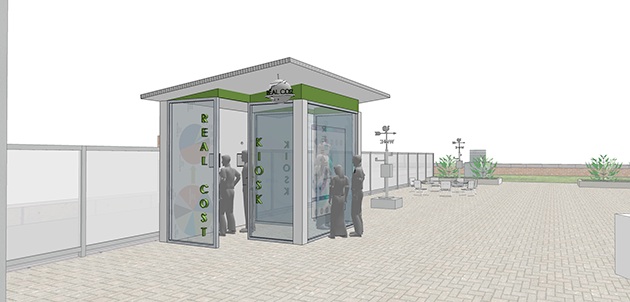
Have you ever wondered about the “real cost” of that cell phone in your pocket – not the price you paid the merchant - but what it really cost in environmental, human capital and economic terms? The Real Cost Kiosk is a student-led initiative created and supervised by students in the Boston Latin School Youth Climate Action Network (BLS YouthCAN) designed to engage students and teachers by provoking a deeper awareness of the “real cost” of the everyday things we take for granted – like that cell phone! The Real Cost Kiosk will impart knowledge about these “real cost” and stimulate conversation and critical thinking about sustainability through a fun, interpretive, highly interactive digital display or “kiosk” that will eventually reside on the rooftop sustainability center at the Boston Latin School. Physically situated on the Green Roof, this innovative new teaching and learning tool will also offer an online web feature that students and teachers anywhere may access and use to increase understanding about global sustainability.
How The Real Cost Kiosk Works
The aim of the Real Cost Kiosk is to enable students and educators to either visit in person or serf to the online Real Cost Kiosk digital display that allows them to click on various items they use in their every day life, and find comprehensive life cycle assessments for those items that are based on detailed research performed by students.
Powerful Learning – The Inquiry-Based Student Research Component
Student researchers who wish to participate more extensively in the Real Cost Kiosk may also work up their own life cycle assessment - the cradle-to-cradle “real cost” - of a new item they wish to see included in the Kiosk. The site will provide a downloadable research template designed by BLS YouthCAN students that will guide student researchers through the assessment process, focusing on analysis in several key categories: Human and Health Cost; Cost to Environment and Natural Resources; Cost to Wildlife Habitat; Cost and Impacts related to Climate Change.
The assessments might consider such questions as:
¬What human labor cost are required to create a particular item? Were the people involved in the extracting, growing, making, producing, transporting, etc. of the item fairly compensated? If not, what secondary cost were incurred by the communities in which these underpaid workers live?
¬What are the environmental and economic cost of the product? What carbon footprint does the item create? What is its planetary carrying capacity? What cost is incurred when it is time to dispose of the item?
If students wanted to assess the “real cost” of their cell phone for example they might begin by trying to discover the environment and natural resources impacts involved in mining the various minerals used to make the phone. They could investigate whether or not the workers engaged in the extraction of those minerals were actually paid a living wage. They might explore what sorts of wildlife habitat impacts (cost) were incurred in the making of the phone, or what toxic wastes might have been generated in the manufacturing process. They could study how much greenhouse gas emissions were generated in the production and transport of the finished product, and what happens to the phone when it is thrown away?
When the assessment process is complete, the research would be submitted for approval through the website, and if approved, uploaded to the Real Cost Kiosk, so that students everywhere may study and weigh in on the new research findings.
The “Service” in Service Learning: Sharing Information and Engaging in Student Fundraisers
Students conducting research for the Real Cost Kiosk will engage in service to the community in the following two ways.
First, their research will be shared with other students. Second, all research projects that are added to the Kiosk must also include a youth-led fundraiser aimed at benefitting non-profit organization partners who are working to address one of the negative impacts that the student researchers have identified in the course of their life cycle assessment for that item (e.g. the negative impacts on natural resources, wildlife habitat, global climate change, public health, economic development, living wage, workforce housing, etc.)
Fundraising Links
Student Research teams are encouraged to conduct a fundraiser that educates about sustainability so that the teaching and learning is integral to this phase of the project as well. Here are some links to environmentally friendly, sustainability focused fundraisers we’ve tried our selves:
We Add Up Fundraiser
We Add Up is the meaningful (and fun!) way to fundraise for your school, college, church, or organization. Educate your community about climate solutions while raising money for your projects. Choose between our OFFLINE or ONLINE fundraisers or do both!
Equal Exchange Fair Trade Fundraiser
http://www.equalexchange.coop/equal-exchange-fundraising
Equal Exchange Fundraising offers organic and fairly traded foods, beautiful fairly traded gifts and recycled cotton gift-wrap (tree-free!). With Equal Exchange Fundraising your organization can support sustainability, enjoy award-winning products and make a difference in the lives of small farmers and artisans across the globe.
Global Goods Fundraisers
http://www.globalgoodspartners.org/template/page.cfm?id=150
Global Goods offers multiple ways to implement educational and socially responsible fundraising programs in your school or community.
Green Raising Earth Friendly Fundraising
Started by a group of eco-minded parents, Green Raising exists to help schools and other nonprofits raise money from sales of useful green products. Many items come from members of Green America’s Green Business Network™, including: EcoBags reusable bags; Laptop Lunches reusable lunchboxes; Fair Trade Zhena’s Gypsy Tea, Ithaca Fine Chocolates, and Peace Coffee; and Earth Friendly Products cleaning supplies.
Heifer International’s Fundraising Ideas
http://www.heifer.org/getinvolved/service-learning-and-fundraising-programs?msource=KIK1J122300
Heifer’s fundraisers can help students do what Heifer does for project partners around the world: inspire others to become part of ever-widening efforts to create a better world. Check out their ideas for all grade levels to get you started.
Project KOPEG
Your group can provide a valuable recycling service for your community while earning needed cash with Project KOPEG’s e-waste recycling fundraiser. Your group collects unwanted cell phones and chargers, ink cartridges, MP3 players, digital cameras, and PDAs to send to the company for cash. As long as you’ve collected at least 30 cell phones, or 30 ink cartridges and 15 cell phones, Project KOPEG will pay all shipping cost. Prices vary according to items—you’ll earn at least $0.95 per pound of e-waste.
International Non-Profit Organization Partners
The proceeds from all student research team fundraisers will be donated to international non-profits that BLS YouthCAN has partnered with for the Real Cost Kiosk. BLS YouthCAN has reached out to the Natural Resource Defense Council, the World Wildlife Fund, the PEW Center on Global Climate Change, John Snow International, the Grameen Foundation, Kiva.org, the National Wildlife Federation, and the Foundation for Environmental Education as organizations designated to receive student research team donations. Other partners may also be identified as the program evolves.
Matching Funds
Student researchers will also be required to attempt to secure matching funds for the monies they have generated from their fundraiser by approaching the company or corporation that makes the item or product they have researched (when applicable) and asking them to donate matching funds to the chosen non-profit. Sample letters to the parent company explaining the Real Cost Kiosk, will be available for download at the Kiosk to streamline this process for student research teams.
The Interactive Real Cost Kiosk - Everyone Participates in the CHEW Score
Not all students or teachers who visit the Real Cost Kiosk will want to conduct their own research for inclusion in the Real Cost Kiosk. Nevertheless, the site is designed to be fun and interactive for non-researching learners as well. Visitors to the Kiosk will be invited to weigh-in by assigning the products in the kiosk something we’ve labeled the CHEW Score (C = Climate Change cost; H = Human and Health Cost; E = Environmental and Natural Resources Cost; W = Wildlife Habitat cost). The rankings will be based on how sustainable the products are on a scale of 1-5 (1=terrible; 2 = poor; 3 = okay; 4 = good; 5= great). In this way, Real Cost Kiosk users will add their thinking and voices to the online product assessments. BLS YouthCAN students who created the Real Cost Kiosk, and who will manage and moderate information flow into and out of the Kiosk, will publish the average and updated scores periodically.
The Real Cost Kiosk on the Shared Green Roof
The Real Cost Kiosk is ultimately headed for installation on BLS YouthCAN’s Shared Green Roof, a student-designed community learning center on sustainability for Boston students and educators now being planned for development on the rooftop of the Boston Latin School. The Green Roof facility will provide students with hands-on, inquiry-based, service learning opportunities that develop skills in systems-thinking and engage them education for sustainability and youth leadership. The Green Roof project is part of a larger effort to “green” the oldest school in the country and to share learning with other schools statewide and beyond.
Through their comprehensive energy action plan and education for sustainability campaign (all of which is shared on the Youth CAN website and promoted via the YC member group network), Youth Can’s vision is to create an outdoor learning space on this urban school rooftop that will engage students and educators in learning about sustainability and will cultivate a sense of stewardship and informed advocacy for our shared planet. The Real Cost Kiosk is a perfect representation of the kind of learning that students will engage in on the Shared Green Roof, and powerfully illustrates how innovative 21st century teaching and learning can advance our shared understanding of the world. It is expected that creation of the Real Cost Kiosk will further demonstrate the vision and educational goals for Shared Green Roof and will help to leverage additional support for project, which promises to be an educational model for the region and beyond.
The Shared Green Roof Youth Task Force Helps Launch the Real Cost Kiosk
The Shared Green Roof Task Force is leading the charge to get the Real Cost Kiosk up and running. BLS YouthCAN students formed the Shared Green Roof Youth Task Force (SGRYTF) in 2011 with representatives from schools and youth organizations from across the city of Boston. The purpose of the SGRYTF is to broadly engage the Greater Boston learning community and schools in the Boston Public School System as participants in developing and promoting the Shared Green Roof project. The SGR Youth Task Force currently has more than 20 participating groups. The Task Force met 5 times in 2012, engaging in design charrettes with Studio G Architects, and introducing the Task Force members to the larger community at the 2012 YouthCAN Annual Climate Summit at MIT. Three of the Shared Green Roof Task Force members, BLS YouthCAN, BAA’s Green Group, and the John D. O’Bryant School are now currently working on product assessments for the Real Cost Kiosk as a Shared Green Roof Task Force development initiative.
Evaluation and Performance Measures
All student researchers will be asked to evaluate their learning experience and evaluations will be posted with their projects on the Real Cost Kiosk. Teachers and students who surf to the Real Cost Kiosk, whether they use it to guide a class research exercise or simply explore the information there, will be invited to answer a few questions evaluating the usefulness of the Real Cost Kiosk and offering any suggestions for improvement. Three surveys - one for educators, one for student researchers, and one for general kiosk users - will be available on the website.
“Systems Thinking” and “Service Learning”
The goals of the Real Cost Kiosk are to provide powerful learning experiences that educate for sustainability, and cultivate the sort of big picture “systems thinking” skills that are critical for today’s students, who must be prepared to lead the way to a more sustainable future. Using the Real Cost Kiosk, students will learn how to consider the triple bottom line of economic, environmental, and social concerns as they pertain to items they use every day. Students will gain an interdisciplinary understanding of the interconnected and interdependent nature of these various systems. In keeping with our Shared Green Roof service-learning model, the student research component and fundraiser requirement of the Real Cost Kiosk will engage students in learning experiences that have real and meaningful impacts in their community and the world beyond, with the intention of fostering lasting commitments to environmental awareness and stewardship among Kiosk users.
BLS YouthCAN Fundraiser Proceeds
Since the first product we researched for the Real Cost Kiosk was on an iPhone, and since our research indicated that workers involved in the making of iPhones do not make a sustainable/living wage, we chose to donate the proceeds from our Fair Trade fundraiser to a non-profit organization called Heifer International (www.heifer.org) that provides aid to address poverty and support living wages for workers around the world.
Partnerships and Partner Organizations
BLS YouthCAN has partnered with numerous people and organizations in order to get this project up and running. We would like to thank: our computer science department, our science department, BLS YouthCAN, Phoebe Beierle, the Sustainability Coordinator for the Boston Public Schools, Michelle Grohe and the Isabella Stewart Gardner Museum, Gail Sullivan and Studio-G Architects, Boston Public Schools Superintendent, Dr. Carol Johnson, Kate Sheehan, Community Engagement Coordinator at Heifer International, William Moomaw at Tufts University, Liz Soper and the National Wildlife Federation, Kayleigh DeMello and Equal Exchange, Brown University, Rhode Island College, The Aperion Center for Sustainability, NYC Global Kids, John Berg and the Environmental Studies Program at Suffolk University, Patricia Weinman and the Technology and Culture Forum at MIT, Boston Arts Academy, The John D. O’Bryant School, the Natural Resource Defense Council, the World Wildlife Fund, The PEW Center on Global Climate Change, John Snow International, the Grameen Foundation, Kiva.org, and the Foundation for Environmental Education
For more information go to www.blsyouthcan.org